Most Service Businesses Are Losing Leads They’ve Already Earned
You’ve done the hard part. Someone has found your business, engaged with your content, submitted an inquiry, or downloaded something from your website. They’re interested… and then nothing happens.
No follow-up. No nurture. No reason for them to choose you over a competitor who does follow up. In a matter of days, a warm lead has gone cold, not because they weren’t a good fit, but because the gap between their interest and your response was too wide.
This is one of the most common and costly problems in service business marketing, and it’s almost entirely solvable with the right email automations in place.
Lead nurturing email flows are pre-built, automated workflows that deliver the right message at the right moment without requiring manual effort every time. They keep your pipeline warm, build trust progressively, and guide prospects toward a decision at their own pace.
In our guide on 7 Benefits of Email Marketing for Service-Based Businesses, we covered why email is one of the most powerful lead generation tools available. Here, we go a level deeper: showing you exactly which 5 automations to build and what to put in each email.
1. The Welcome Flow
What is a Welcome Flow?
The welcome flow is the first impression your email programme makes. It’s triggered the moment someone joins your list, whether through a lead magnet, contact form, website sign-up, or in-person event. Done well, it sets the tone for the entire relationship.
When to Use a Welcome Flow
This automation fires for every new subscriber or lead, regardless of how they found you. It’s your baseline—the automation that every other flow builds on.
What to Include in Your Welcome Flow
| Timeframe | Messaging Strategy | Subject Line Example | |
|---|---|---|---|
| Email 1 | Immediate (0 mins) | Deliver what was promised (lead magnet, resource, or confirmation). Keep it clean, warm, and on-brand. Don’t oversell. | Here’s what you asked for [First Name] |
| Email 2 | Day 2 | Introduce who you are and what you do in plain language. Focus on the problem you solve, not your credentials. | What we actually do (and who we do it for) |
| Email 3 | Day 4 | Share a piece of genuinely useful content (a blog, guide, or quick tip) that’s directly relevant to why they signed up. | One thing most [industry] businesses get wrong |
| Email 4 | Day 7 | Social proof. A short client story or tangible result that shows what’s possible when someone works with you. | How [Client Name] achieved [Result] in [Timeframe] |
| Email 5 | Day 10 | Soft call to action. Invite them to book a call, start a conversation, or explore a relevant service—without pressure. | Whenever you’re ready, here’s the next step |
Platform Tip: Set this up in ActiveCampaign, HubSpot, or Klaviyo as an automation triggered by list join or form submission. Tag subscribers based on which lead magnet they downloaded so you can personalise follow-up automations later.
2. The Lead Nurture Flow
What is a Lead Nurture Flow?
The lead nurture flow is the workhorse of your email programme. It’s designed for prospects who are aware of you and interested, but not yet ready to buy. Its job is to progressively build trust, demonstrate expertise, and move them closer to a decision—without being pushy.
When to Use a Lead Nurture Flow
This automation runs after the welcome flow completes. It’s particularly important for service businesses with longer sales cycles, where prospects often need multiple touchpoints before they’re ready to have a conversation.
What to Include in Your Lead Nurture Flow
| Timeframe | Messaging Strategy | Subject Line Example | |
|---|---|---|---|
| Email 1 | Week 2 | Address the most common objection or concern prospects have before working with you. Be honest and direct. | The question we get asked before every project |
| Email 2 | Week 3 | Educational deep-dive. Share a framework, process, or insight that shows how you think and approach problems. | How we approach [key challenge] (and why most businesses get it wrong) |
| Email 3 | Week 4 | Case study or client story. Make it specific: name the challenge, describe the approach, share the outcome. | How [Client] went from [Problem] to [Result] |
| Email 4 | Week 5 | Industry insight or trend that’s relevant to your prospects’ world. Position yourself as someone worth listening to. | What’s changing in [industry] in 2026 and what to do about it |
| Email 5 | Week 6 | FAQ email. Answer the three or four questions you get asked most often before someone decides to work with you. | Your questions, answered |
| Email 6 | Week 7 | Direct CTA. Invite them to book a consultation, discovery call, or strategy session. Make it easy and low-commitment. | If you’re ready to talk, here’s how to get started |
Key Principle
The lead nurture flow should feel like a conversation, not a broadcast campaign. Every email should provide standalone value—something useful even if the prospect never becomes a client. That’s what builds the kind of trust that converts.
3. The Enquiry Follow-Up Sequence
What is an Enquiry Follow-Up Sequence?
Someone has made an inquiry. They’ve raised their hand. This is the highest-intent moment in the lead journey, and the follow-up flow is what you put in place to make sure that moment isn’t wasted.
Speed and consistency matter here more than anywhere else. Research consistently shows that the chances of reaching a lead drop dramatically within the first hour of an inquiry. Automated follow-up solves this entirely.
When to Use an Enquiry Follow-Up Sequence
Triggered immediately when a prospect submits a contact form, books a discovery call, or sends a direct inquiry. Runs alongside (or instead of) manual sales follow-up depending on your team’s workflow.
What to Include in Your Enquiry Follow-Up Flow
| Timeframe | Messaging Strategy | Subject Line Example | |
|---|---|---|---|
| Email 1 | Immediate (within 5 mins) | Acknowledge the inquiry. Confirm receipt, set clear expectations for response time, and provide useful context (a case study or process overview). | We’ve received your inquiry, here’s what happens next |
| Email 2 | Day 2 (if no response) | A short, friendly follow-up. Check they received your initial response and reiterate your availability. Keep it human, not salesy. | Just checking in, [First Name] |
| Email 3 | Day 5 (if still no response) | Share something valuable while they evaluate options: a client result, a short audit checklist, or a relevant resource. | Something that might be useful while you’re considering your options |
| Email 4 | Day 10 (final follow-up) | A clear, low-pressure close. Let them know this is your last follow-up, invite them to reconnect whenever they’re ready, and leave the door open warmly. | Leaving the door open, no pressure |
Why This Sequence Matters
Many service businesses rely entirely on manual follow-up for enquiries—which means response times are inconsistent, leads slip through the cracks, and follow-up quality depends on how busy the team is. An automated campaign removes that inconsistency entirely and ensures every inquiry gets a professional, timely response every time.
4. The Re-Engagement Sequence
What is a Re-Engagement Sequence?
Not every lead converts on the first cycle. People get busy, priorities shift, budgets change. A re-engagement flow is designed to win back contacts who have gone quiet—whether that’s prospects who stopped engaging with your nurture emails or past clients you haven’t heard from in a while.
When to Use a Re-Engagement Sequence
Triggered by inactivity. Set a threshold that makes sense for your sales cycle—typically 60 to 90 days of no opens, clicks, or responses for cold prospects; 6 to 12 months for past clients.
What to Include in Your Re-Engagement Flow
| Timeframe | Messaging Strategy | Subject Line Example | |
|---|---|---|---|
| Email 1 | 60 days of no engagement | A direct, honest subject line that acknowledges the silence. No pretence. Ask if they’re still interested or if their situation has changed. | It’s been a while, [First Name]. Still on your radar? |
| Email 2 | 3–5 days later | Share something genuinely new: a recent case study, a service update, or a relevant industry insight. Give them a reason to re-engage. | Something new that might be relevant to you |
| Email 3 | 5–7 days later | A final check-in. Let them know you’ll stop reaching out if you don’t hear back. This creates urgency without being aggressive. | Last one from us, but the door’s always open |
For Past Clients
Adapt the tone for existing relationships. Acknowledge the time that’s passed, reference what you worked on together, and make it easy for them to reconnect. A simple “how are things going since we worked together?” with a genuine question about their current situation often outperforms any polished marketing email.
List Hygiene Tip
Use the re-engagement flow as an opportunity to clean your list. Contacts who don’t respond to all three emails should be removed or suppressed. A smaller, more engaged list always outperforms a large, inactive one—particularly for deliverability and inbox placement.
5. The Client Onboarding Flow
What is a Client Onboarding Flow?
Most service businesses treat onboarding as an operational process: contracts, kickoff calls, briefing documents. And while those things matter, the onboarding email flow is about something different: making a new client feel confident, valued, and certain they made the right decision.
The period immediately after someone signs is one of the most emotionally charged moments in the client relationship. Buyer’s remorse is real, particularly for higher-value services. A well-designed onboarding flow reinforces the decision, sets clear expectations, and lays the foundation for a long-term partnership.
When to Use It
Triggered when a new client is marked as ‘won’ in your CRM or signs a contract. Runs in the first two to four weeks of the engagement.
What to Include in Your Client Onboarding Flow
| Timeframe | Messaging Strategy | Subject Line Example | |
|---|---|---|---|
| Email 1 | Immediately on sign-up | A warm, personal welcome. Thank them genuinely, confirm what happens next, and introduce anyone else on your team they’ll work with. | Welcome to the team, [First Name]. Here’s what’s next. |
| Email 2 | Day 2 | Practical onboarding steps. What do you need from them? What will they receive from you? What does the first two weeks look like? | Everything you need to get started |
| Email 3 | Day 7 | A check-in. Ask how they’re feeling about the start of the engagement. Is there anything they’re unclear on? Catch small concerns early. | A quick check-in from us |
| Email 4 | Day 14 | Early win. Share any early progress, initial audit findings, or a first result, even something small. This reinforces momentum. | Here’s what we’ve been working on |
| Email 5 | Day 30 | First month reflection. Summarise progress, reiterate the roadmap ahead, and invite any feedback. | One month in. Here’s where we are. |
Why This Is Often Overlooked
Most service businesses put significant effort into winning a client and relatively little into the period immediately after. But the onboarding experience has a direct impact on client satisfaction, retention, and referrals, which are ultimately the most valuable outcomes of any client relationship.
Putting It All Together: How These Sequences Work as a System
While each of these automations is valuable on its own, the real power comes when they work together as a connected system. Here’s how a typical lead journey flows through all five:
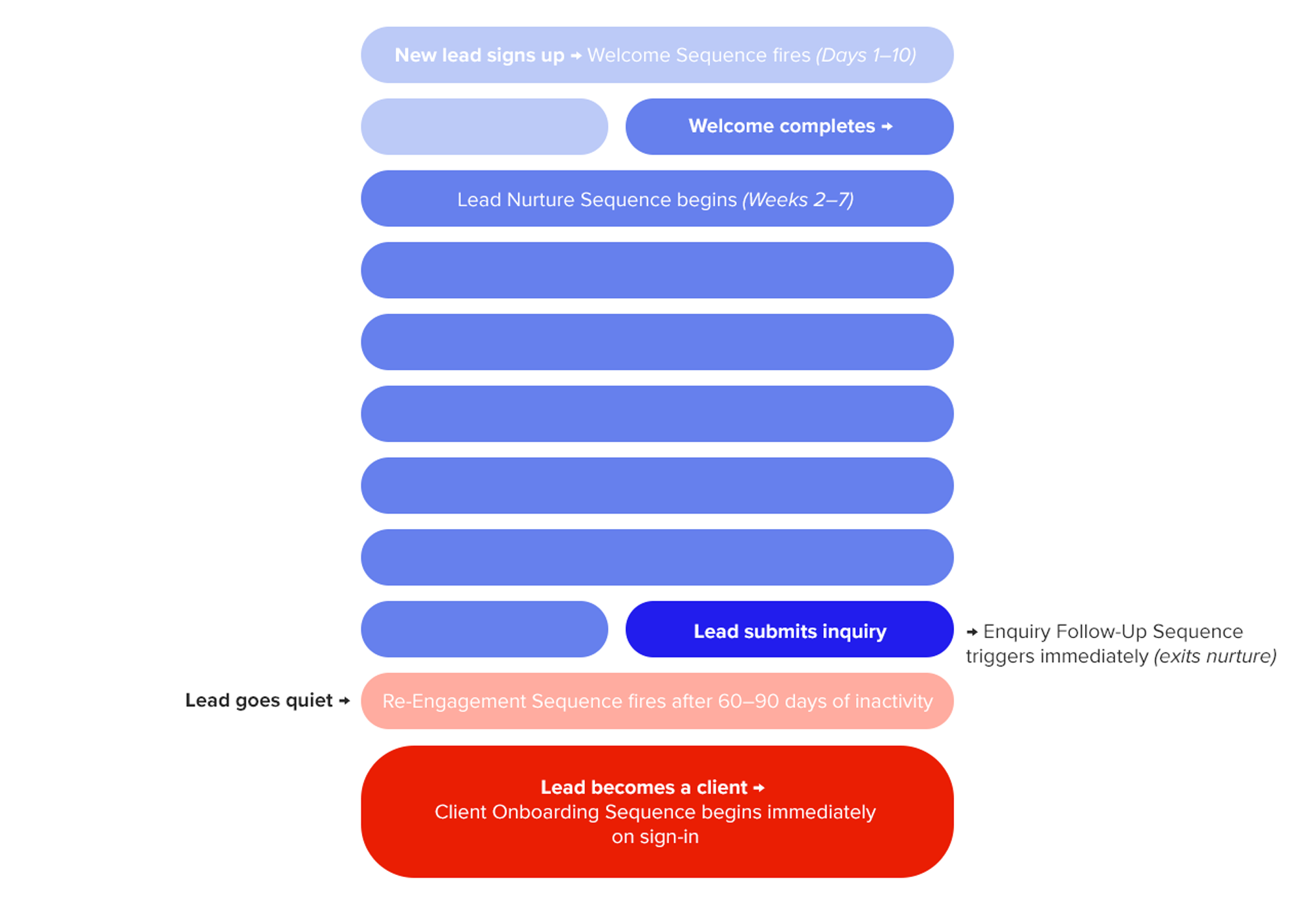
With this system in place, no lead is ever left without a touchpoint. No new client starts without a clear, professional welcome. And no past relationship goes cold without a structured attempt to reconnect.
Which Platform Should You Build This In?
The right platform depends on your business size, existing tech stack, and how sophisticated you need your automation logic to be:
- HubSpot: Best for B2B service businesses that want email tightly integrated with their CRM, sales pipeline, and contact management. Offers powerful automation, robust reporting, and excellent multi-touch attribution.
- ActiveCampaign: Excellent for service businesses that need flexible, behaviour-based automation without the enterprise price tag. Features strong deal pipeline tracking and an intuitive visual automation builder.
- Klaviyo: Primarily known for ecommerce, but increasingly adopted by service businesses for its powerful segmentation and data-driven approach. A strong choice if you already use it across other divisions.
- Mailchimp: A solid starting point for smaller service businesses or those just beginning to build out email automation. More limited on advanced conditional logic, but accessible and straightforward to deploy.
Whichever platform you use, the automations above can be adapted to fit. The strategy matters more than the tool.