The Battle for the Inbox: Why Subject Lines Make or Break Your Campaign
Have you ever spent hours crafting a beautifully designed email newsletter or promotional campaign, only to watch it land with a dishearteningly low open rate?
Customer inboxes are more saturated than ever. With dozens of promotional emails competing for attention every morning, subscribers make split-second decisions on which messages to open, archive, or delete.
The gatekeeper to your entire email marketing funnel is the subject line. If your subject line doesn’t capture interest within two seconds, the rest of your email content—no matter how valuable—will never be read.
Here are five proven copywriting strategies to make your subject lines stand out in a crowded inbox.
1. Keep Your Subject Lines Concise
Long subject lines run a heavy risk of being truncated, especially on mobile devices where over 55% of all emails are first viewed.
Keep your subject lines short and punchy for maximum readability. Mailchimp recommends keeping subject lines under 9 words or 60 characters to ensure your core hook isn’t cut off by mobile email clients.
Tone of voice is equally crucial. Writing in an active voice and employing strong action verbs immediately grabs attention.
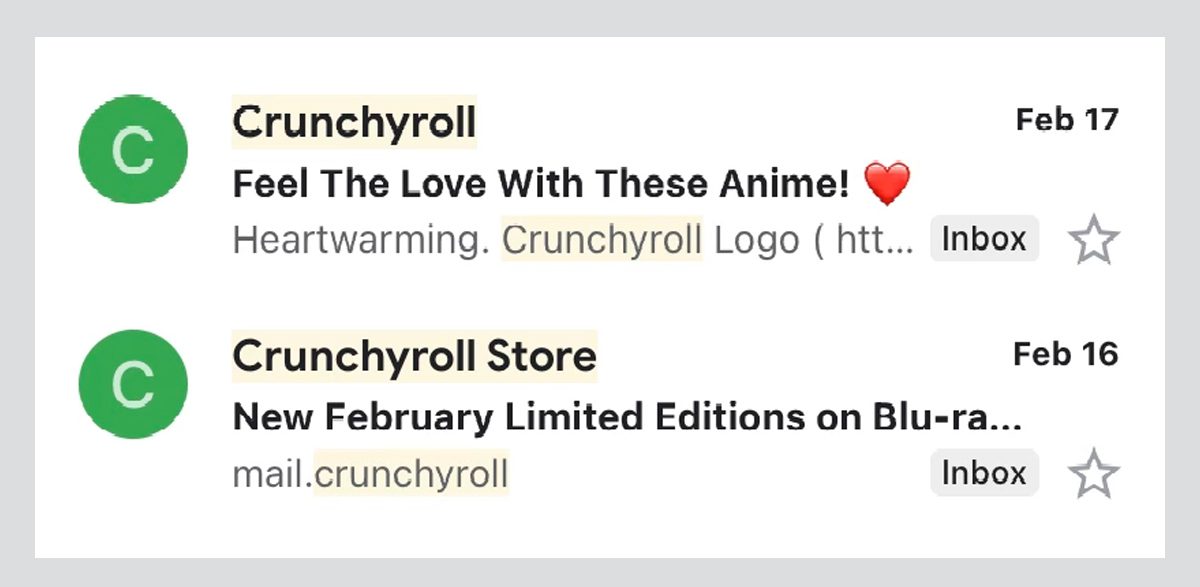
Example: Crunchyroll subject line comparison
Notice how the concise subject line using direct action verbs is far more clickable and engaging than a convoluted, text-heavy alternative.
2. Pique Curiosity (The Information-Gap Theory)
One of the most powerful psychological drivers in human decision-making is curiosity.
Behavioral economist George Loewenstein pioneered the Information-Gap Theory, which demonstrates that when individuals perceive a gap between what they know and what they want to know, they feel a compelling desire to close that gap.
Proven Ways to Spark Curiosity in Subject Lines:
- Ask a thought-provoking question: e.g., “Are you making this common email mistake?”
- Employ curiosity power words: words like secret, unusual, surprising, behind the scenes.
- Introduce slight controversy: e.g., “Why discounting is killing your margins.”
- Withhold the punchline: Provide enough context to intrigue, but leave the payoff inside the email.
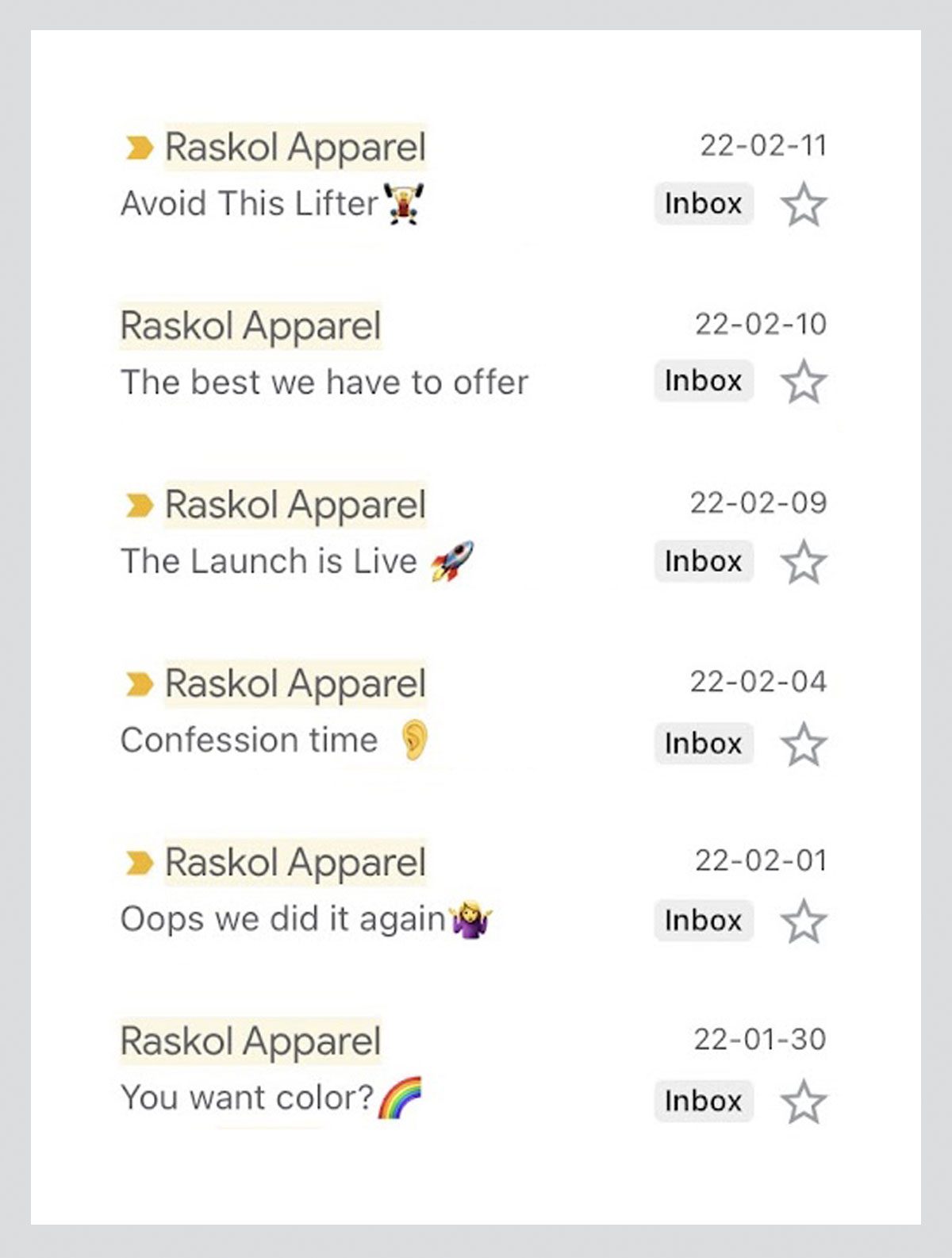
Example: Curiosity-driven subject lines from Raskol Apparel
By presenting an intriguing hook without giving away the full answer, you make opening the email irresistible.
3. Make It Fun: Emojis, Puns, and Personality
Adding lighthearted personality gives your brand humanity and breaks the monotony of generic corporate correspondence.
Using popular, relevant emojis (like ☕, 🚀, or 🔥) creates immediate visual pop among lines of plain text. At <imajery>, we frequently utilize the reading glasses (👓) or checkmark (✅) emojis to signal actionable learning and strategic clarity.
Other Ways to Add Creative Spark:
- Clever puns: Wordplay related to your niche or seasonal events.
- Rhyming schemes: Rhythm and rhyme increase cognitive processing fluency.
- Pop culture references: Timely nods to trending moments or cultural memes.
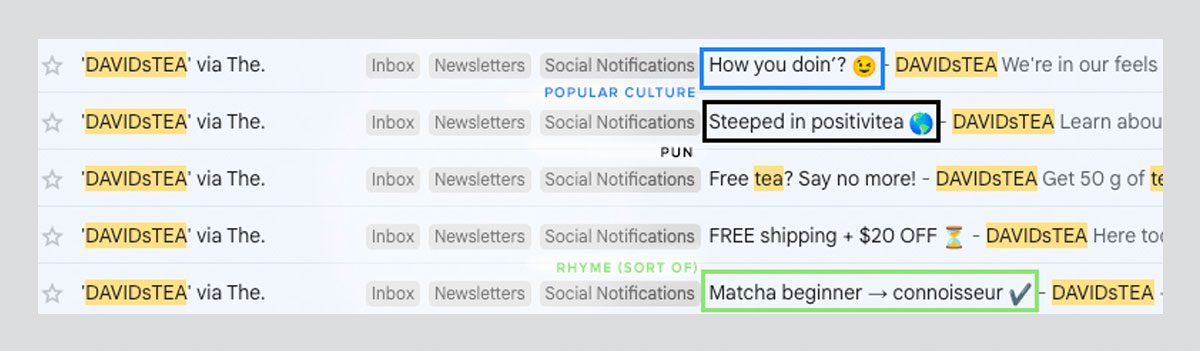
Example: Puns and playful tone from David’s Tea
David’s Tea excels at this: blending playful puns, relevant emojis, and friendly warmth to build approachable customer relationships.
4. Use Urgency (Ethically and Sparingly)
Pairing a promotional incentive with authentic urgency is a proven catalyst for customer action.
Phrasing like “Ends at midnight”, “Final call”, or “Only a few spots left” motivates subscribers who have been procrastinating to make a decision immediately.
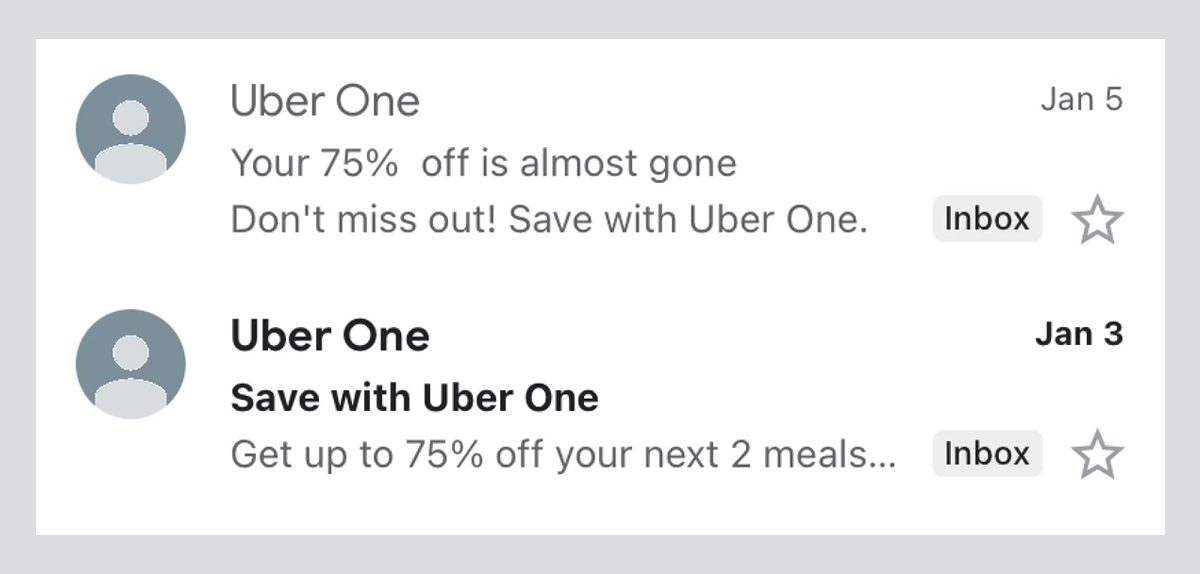
Example: FOMO and urgency in Uber One promotional follow-ups
In this example from Uber One, an initial generic notification was easily ignored. However, the subsequent follow-up leveraged urgency and FOMO (fear of missing out), creating renewed interest in the discount.
Caution: Use urgency authentically. Manufacturing fake deadlines or sending “urgent” notices every three days destroys credibility and leads to high unsubscribe rates.
5. Test, Test, and Retest
Every brand has a distinctive subscriber demographic with unique motivations, reading habits, and preferences. What drives record open rates for a fitness DTC brand may flop for a B2B SaaS platform.
The only way to know with certainty is A/B split testing:
- Test a short subject line against a longer descriptive line.
- Test an emoji-rich variant against a minimalist plain-text angle.
- Test a curiosity question against a direct benefit statement.
Over time, these test results will help you establish a data-backed playbook custom-tailored to your audience.
Take Your Open Rates to the Next Level
Mastering email subject lines is one of the highest-leverage skills in direct response marketing. Apply these five principles on your next campaign broadcast, measure your open rates, and watch your engagement metrics climb.